Published on: April 13, 2026
6 min read
GitLab named a 2026 Omdia Universe Leader
Omdia's 2026 report on AI-assisted software development ranked 19 vendors. Here is what GitLab's top scores mean for engineering teams.


GitLab is named a Leader in the 2026 Omdia Universe for AI-assisted Software Development, IDE-based Tools. Of the nineteen vendors evaluated by the independent analyst firm, GitLab earned best-in-class scores in three categories: Solution Breadth (100%), Strategy and Innovation (88%), and Core Features (82%). Top-tier ratings followed for Extended Features and Vendor Execution.
This year's assessment is notable for a specific reason: Omdia expanded its evaluation criteria, and for the first time, AI development tools were scored on full software lifecycle capability, not just coding. That shift mirrors where the AI evolution is heading and shook up which vendors came out on top.
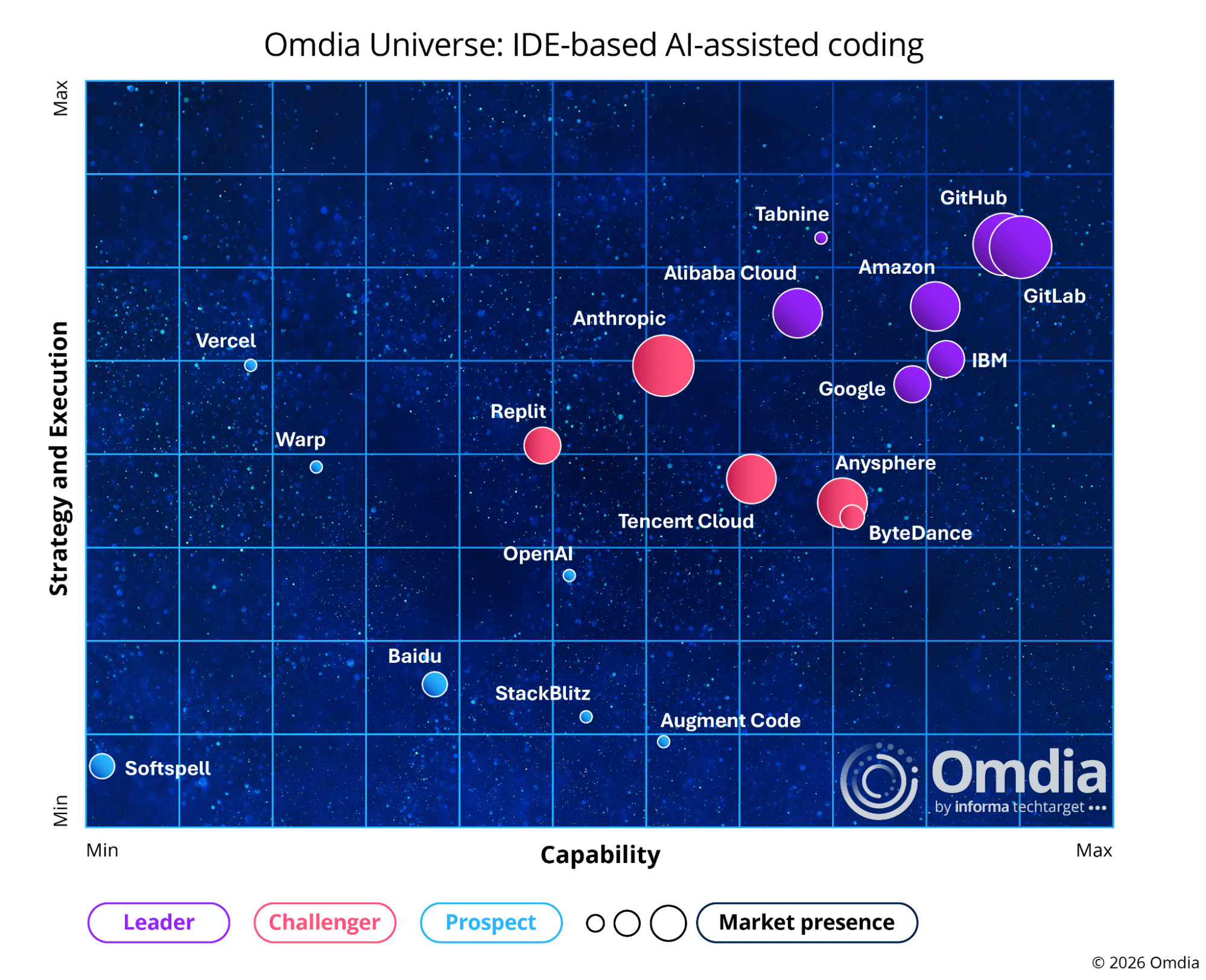 Source: Omdia, Universe: AI-assisted Software Development, Part 1: IDE-based Tools, 2026
About Omdia Universe
Omdia Universe plots vendors across Solution Capability and Strategy and Execution, producing three tiers: Leaders (strongest on both axes, recommended for every shortlist), Challengers (narrower feature range or earlier in maturity), and Prospects (earlier-stage or adjacent-fit vendors).
What changed in this year's assessment
The expansion of Omdia's criteria reflects something practitioners are already experiencing. AI coding tools have raised developer output significantly, and applications that once took weeks can now be prototyped in a fraction of the time. But acceleration at the coding stage does not automatically translate to faster delivery. Review backlogs grow. Security findings accumulate. Deployments still require coordination across teams using tools that were not designed to work together.
Omdia captured this dynamic directly: The tools pulling ahead are the ones that handle testing, security, deployment, and orchestration. Not just code generation. That finding drove the decision to broaden the assessment criteria and separated the Leaders from the Challengers.
The other major shift in this year's report is how Omdia treated agentic AI. The 2026 assessment weighted agentic capabilities as a current evaluation dimension rather than a future consideration. This includes whether a platform can coordinate multiple tasks autonomously, orchestrate handoffs between specialized agents, and support teams at different stages of agent adoption.
Where GitLab scored
GitLab earned best-in-class scores in three categories:
Solution Breadth: 100%. Coverage of the full SDLC in a single platform, from planning and requirements through deployment and issue management. This includes lifecycle phases that most AI coding tools do not touch. For example, prebuilt agents like Planner Agent and Security Analyst Agent extend AI assistance into sprint planning, vulnerability triage, and remediation guidance: the parts of the lifecycle where delivery actually gets stuck.
Strategy and Innovation: 88%. Differentiation through end-to-end orchestration, privacy-first architecture with no training on private data, and multi-model support via partnerships with Anthropic, Google, and AWS. Teams can select models suited to their workload and data requirements. The platform's approach to unified context, where agents collaborate across issues, merge requests, pipelines, and security findings without losing state, is an example of the architectural innovation Omdia recognized in this category.
Core Features: 82%. This score reflects deep coverage across the parts of the lifecycle where engineering teams spend most of their time. Code is generated with real-time context from the IDE and codebase, tested across unit, integration, and security dimensions, and reviewed with prioritization built in. DevOps automation handles CI/CD, GitOps, and root cause analysis for pipeline failures. The AI Impact Dashboard gives teams measurable visibility into cycle times, deployment frequency, and where AI is actually moving the needle on productivity.
GitLab also earned top-tier recognition for Extended Features (80%) and Vendor Execution (88%).
The changing role of human developers and AI agents
One of the more substantive findings in the Omdia report concerns the evolving role of the software developer alongside these tools. Development teams are increasingly a mix of AI engineers and their AI agents, with engineers supervising and directing agentic AI. With AI coding generating the bulk of the code, the human's job shifts toward ensuring technology requirements are actually met, supervising quality, applying right guardrails, designing autonomous production pipelines, and mediating between business goals and the use of agentic AI across the software lifecycle.
This shift has implications for how organizations evaluate their AI investments. A team that has automated code generation but still handles review, testing, and deployment manually has not yet truly accelerated software innovation. The productivity gain from faster coding compounds when the rest of the lifecycle can keep pace. It shrinks when it cannot, and the bottlenecks move downstream instead.
Enterprise readiness as table stakes
Something notable in how Omdia structured this year's assessment: enterprise controls and guardrails are no longer a bonus category. Compliance certifications, deployment flexibility, and privacy architecture appeared as baseline expectations for Leader-tier platforms, not as distinguishing features. Organizations in regulated industries and those with data sovereignty requirements are now weighing these factors as entry criteria.
GitLab's posture on these dimensions highlight its unique differentiation in the market: SOC 2 and ISO 27001 certified platform, privacy-first design with no training on private customer data for its agentic AI capabilities, self-managed deployment support across cloud and on-premises (including air-gapped environments), and support for self-hosted AI models. Its consumption as a single-tenant SaaS application via GitLab Dedicated, with FedRAMP Moderate Authorized via GitLab Dedicated for Government, extends its leadership in deployment flexibility.
The Omdia report recognized these not as a feature list but as evidence of the platform's readiness for the organizations where the compliance bar is highest: financial services, government, healthcare, and other regulated sectors that cannot compromise on data residency or auditability.
Benchmark your maturity in software development
For teams actively evaluating where their AI development strategy stands, Omdia's recommendation is clear: GitLab belongs on the top of the list.
The deeper question for most engineering leaders right now is not which AI tool generates the best code. It is whether the code being generated can be put to production with the highest level of quality, security, and performance. It must be understood, governed, and maintained by the software teams responsible for it. With GitLab, coding speed translates to innovation velocity.
If you want to benchmark your organization’s maturity in software development best practices and evolution, you can get a personalized score and concrete next steps to take in these assessments for AI Modernization, DevOps Modernization, and Security Modernization.
More to explore
View all blog posts

We want to hear from you
Enjoyed reading this blog post or have questions or feedback? Share your thoughts by creating a new topic in the GitLab community forum.
Share your feedback